MQTT is the device-facing message boundary for the OttO IoT gateway. Collection stations publish sensor readings. Control stations subscribe to command topics. OttO sits in the middle, receives telemetry, updates its local state, and makes that state available to REST and WebSocket clients. The broader IoT System Architecture article shows where this message boundary fits in the device-to-cloud path.
Why This Matters
MQTT is the boundary that keeps devices, gateways, dashboards, and storage from needing to know too much about each other. A good topic model lets telemetry flow through the system without turning every component into a direct dependency of every other component.
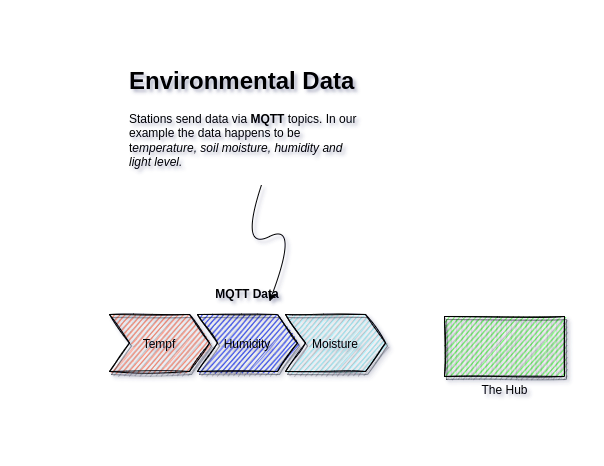
This article focuses on the MQTT side of the gateway. For the broader architecture, see OttO: A Go-Based IoT Edge Gateway Architecture.
Why MQTT Fits the Device Boundary
MQTT works well for small device networks because it is simple, lightweight, and based on publish/subscribe messaging. A collection station does not need to know which dashboard, database, or application will consume a reading. It only needs to publish a message to a known topic.
That separation is useful in an IoT system:
- Devices can publish readings without knowing about HTTP clients.
- The gateway can subscribe to many stations with a small number of topic filters.
- Control stations can listen for command messages without exposing an HTTP server.
- Test tools can publish fake sensor readings without running real hardware.
MQTT does not replace the gateway. It gives devices a compact messaging protocol, while OttO provides the application boundary around that message stream.
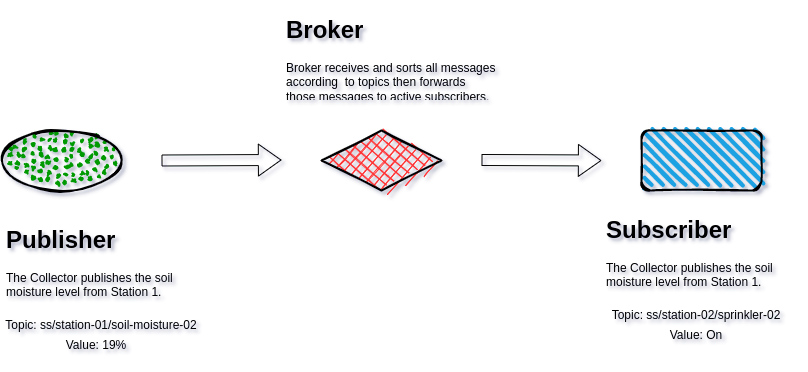
MQTT Architecture
MQTT has three primary roles:
- Publisher: a client that sends a message to a topic.
- Broker: the server that receives messages and routes them.
- Subscriber: a client that receives messages matching a topic filter.
In the garden project, a collection station is a publisher, the MQTT broker routes the message, and OttO is a subscriber. For command flows, OttO can publish commands and a control station can subscribe to them.
That pattern keeps each component small. Devices do not call the REST API. The dashboard does not subscribe directly to raw device topics. The gateway translates between device messages and application-facing interfaces.
Topic Design Is API Design
MQTT topics look informal because they are just strings, but they become an API as soon as more than one component depends on them. Treat them with the same care as REST paths or event names.
A simple telemetry topic shape for this project is:
ss/data/{stationid}/{sensorid}
For example, a station with ID 10.11.4.22 publishing a Fahrenheit
temperature reading can use:
ss/data/10.11.4.22/tempf
This topic tells OttO three things:
ssidentifies the sensor-station namespace.dataidentifies this as telemetry.10.11.4.22identifies the station.tempfidentifies the sensor.
The topic should carry routing and identity information. The payload should carry the reading. Avoid hiding too much meaning in positional segments, and document the topic scheme before adding more devices.
Good topic contracts answer these questions:
- Which component owns this topic namespace?
- Which topic segments are stable identifiers?
- What payload format is expected?
- How are new versions introduced?
- What should happen when an unknown topic is received?
The broader device-to-cloud article covers this boundary in more depth: IoT System Architecture: Device to Cloud.
Connecting from Go
OttO uses the Eclipse Paho MQTT client for Go:
go get github.com/eclipse/paho.mqtt.golang
A small gateway should make the broker address configurable. During
local development it might be localhost; in a deployed environment it
may be a broker running elsewhere on the network.
package main

import (
    "flag"
    "log"

    mqtt "github.com/eclipse/paho.mqtt.golang"
)

type Config struct {
    Broker string
    ClientID string
}

var config = Config{}

func init() {
    flag.StringVar(&config.Broker, "broker", "tcp://localhost:1883", "MQTT broker URL")
    flag.StringVar(&config.ClientID, "client-id", "otto-gateway", "MQTT client ID")
}

func connectMQTT() mqtt.Client {
    opts := mqtt.NewClientOptions()
    opts.AddBroker(config.Broker)
    opts.SetClientID(config.ClientID)

    client := mqtt.NewClient(opts)
    token := client.Connect()
    token.Wait()
    if err := token.Error(); err != nil {
        log.Fatal(err)
    }

    return client
}
The important design point is not the exact flag package usage. The important point is that broker configuration belongs outside the device message handler so the gateway can move between development, lab, and field deployments.
Subscribing to Sensor Data
MQTT supports wildcards in subscription filters. The + wildcard
matches exactly one topic segment, so OttO can subscribe to telemetry
from every station and sensor with one filter:
ss/data/+/+
A subscription can bind that filter to a callback:
func subscribeData(client mqtt.Client, handler mqtt.MessageHandler) error {
    token := client.Subscribe("ss/data/+/+", 0, handler)
    token.Wait()
    return token.Error()
}
That callback receives every matching message. It is responsible for validating the topic, extracting identifiers, and handing the reading to the rest of the gateway.
type Reading struct {
    StationID string
    SensorID  string
    Payload   []byte
    Received  time.Time
}

func dataHandler(readings chan<- Reading) mqtt.MessageHandler {
    return func(client mqtt.Client, msg mqtt.Message) {
        parts := strings.Split(msg.Topic(), "/")
        if len(parts) != 4 || parts[0] != "ss" || parts[1] != "data" {
            log.Printf("ignoring unexpected topic %q", msg.Topic())
            return
        }

        reading := Reading{
            StationID: parts[2],
            SensorID:  parts[3],
            Payload:   append([]byte(nil), msg.Payload()...),
            Received:  time.Now(),
        }

        readings <- reading
    }
}
The callback should stay small. It should validate and enqueue the message quickly, then return control to the MQTT client. Parsing, storage, API updates, and control decisions can happen in gateway code that consumes from the channel.
Passing Readings Through the Gateway
A Go channel is a useful boundary between the MQTT callback and the rest of the gateway. The callback writes readings into the channel; a gateway worker reads from the channel and updates state.
func runCache(readings <-chan Reading, cache *Cache) {
    for reading := range readings {
        cache.Add(reading)
    }
}
That division keeps protocol handling separate from state management.
It also makes the system easier to test: test code can publish MQTT
messages through a broker, or it can send Reading values directly into
the cache worker.
Internal Data Model
The gateway stores recent data by station and sensor. Conceptually, the shape looks like this:
That structure makes lookup straightforward for the REST API: clients can ask for one station, one sensor, or a bounded range of readings. The companion REST article covers that client-facing boundary: Adding the REST API to IoT Gateway.
Memory and Backpressure
An MQTT gateway must be explicit about memory. If every reading is kept forever, memory grows with the number of stations, the number of sensors, and the publish rate.
A proof-of-concept gateway can use an in-memory cache, but it still needs limits:
- Keep only the most recent
Nreadings per sensor. - Drop or overwrite old readings when a sensor reaches its limit.
- Use buffered channels intentionally, not as an accidental infinite queue.
- Measure dropped messages, queue depth, and cache size.
- Move durable history to a database when historical analysis becomes a product requirement.
A bounded per-sensor ring buffer is often enough for live dashboards and short local queries. Durable storage is a separate backend concern. The edge gateway should keep enough state to operate locally, but it should not become an unbounded time-series database by accident.
Backpressure deserves the same attention. If the cache worker cannot keep up with the MQTT callback, the system needs a policy: block, drop, sample, or fail visibly. Silent queue growth is the worst option because it hides the problem until the gateway runs out of memory.
Testing with MQTT Tools
MQTT is easy to test because tools can stand in for device stations.
The mosquitto_pub command can publish a fake reading into the same
topic path used by a real collection station:
mosquitto_pub -t ss/data/10.11.1.11/tempf -m 98.6
OttO should receive the message, parse 10.11.1.11 as the station ID,
parse tempf as the sensor ID, and store 98.6 as the reading payload.
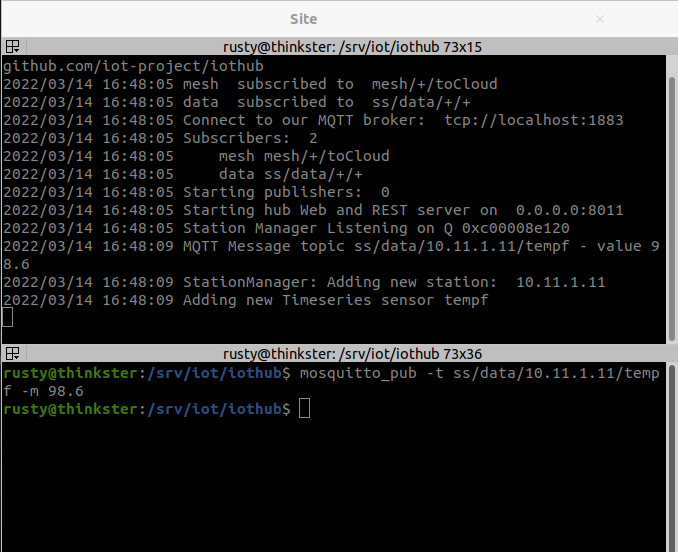
This kind of system test is valuable because it exercises the external contract. The test does not need to know about gateway internals. It only needs a broker, a topic, a payload, and an observable result from the gateway.
Common Pitfalls
Topic Paths Without Ownership
If every device invents its own topic path, the gateway becomes a pile of special cases. Define the namespace and keep it stable.
Payloads Without Versioning
Plain numeric payloads are fine for early tests, but richer payloads need a versioned shape. A JSON payload with explicit fields is easier to extend than a positional string format.
Blocking Inside the Callback
The MQTT callback should not do expensive work. Validate the message, copy the payload if needed, enqueue it, and return.
Unbounded Local State
A live dashboard cache is not the same thing as durable storage. Put a limit on in-memory readings and add a real storage layer when the system needs history.
Where This Fits
MQTT is one boundary in the larger system. The related articles show the rest of the path: